Since the early 1950’s there has been a connection in the intersection of Black American and Palestinian activism. The historic alliance has been rooted in the global fight against racism, imperialism and capitalism. While I do believe that no one in the history of the world has faced the same struggles and challenges that Black Americans have faced, I do believe that if there is one group of people who are just as resilient and just as understanding, that it is our Palestinian Brothers and Sisters. I encourage many Black Americans to have this same courage, respect and understanding of the Palestinian peoples struggle because there is a deeper relatable connection between the two communities. For about 70 years, Black political leaders such as Malcolm X, Angela Davis, Ralph Bunche, Stokely Carmichael and Marc Lamont Hill have all courageously continued to support Palestine and its people and continue to speak out about the blatant Zionism that has taken the lives of countless Palestinians. Important to add, these same individuals have also taken a stand against the media that has totally demonized anyone speaking out in support of Palestine. It Saddens me when I hear Black Americans who aren’t politically knowledgeable, have ignorant opinions about a world crisis. This truly confuses me because of our shared experiences. Both communities are fighting the same oppressor. Both communities have parallels of state violence and militarized police, surveillance and incarceration and displacement and dispossession. Palestinians have been displaced and removed from their homes and ancestral land due to the ongoing Israeli occupation fueled and funded by the American Government, while Black Americans have experienced violence and displacement in the United States as well, mostly through practices like slavery, redlining, mass incarceration and Jim Crow Laws. Both communities have a struggle for self-determination and a right to control their own destinies.
In a 1958 press conference Malcolm X stated he “Would be completely in sympathy with the Arab cause.” This was one of the earliest, most powerful quotes that I could find from Malcolm in his early political activist days. By the 1960’s, Malcolm X was well documented being in support of the Palestinian people. Particularly during the latter years of his life, after Malcolm began to leave the Black nationalist and separatist Nation of Islam, Malcolm began to interact with leaders and organizers across the globe. During his extensive travels to the middle east, Malcolm would eventually meet with many Pan-Arab leaders who helped broaden his mindset and ideology. On his second trip to Gaza in 1964 Malcolm visited the Khan Younis Refugee Camp for displaced Palestinians, (first being in 1959, not a lot of documentation about this trip) Malcolm was perplexed. He realized there was a direct connection in the struggles of the people in Palestine with his brothers and sisters at home. “I, for one, would like to impress, especially upon those who call themselves leaders, the importance in realizing the direct connection between the struggle of the Afro-American in this country and the struggle of our people all over the world,” Malcolm said upon his return to America in New York in December 1964. He learned about the Khan Younis Massacre of 1956 and met with some survivors of the massacre as well who were able to tell him their stories. During the Massacre, Israeli forces went home to home executing almost 300 Palestinians. Malcolm left Gaza the next day angry, sad and full of emotion and this led him to write probably his most famous writing piece “Zionist Logic.” In the piece,he describes Zionism as “a new form of colonialism” which appears to be “benevolent” and “philanthropic”. He warned that newly independent African countries in economic difficulty were being exploited by Israel through economic aid and assistance. Malcolm also accused the West of strategically attempting to divide Africans and Asians, through the creation of the state of Israel. Most importantly, Malcolm challenged Israel’s right of a “state based on a promised land.” In summary Malcolm claimed that the present occupation of Arab Palestine has no intelligent or legal basis in history. Malcolm X was eventually killed within 6 months of this piece being released but the attitude, ideas and knowledge in the writing still influence Black leaders to be pro-Palestine and no better example of this was in this Black Panther Party.
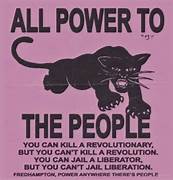
“The Black Panther Party unequivocally supports the Palestinian people and their vanguard forces in their struggle against the [Zionist] aggressors and the Hussein reactionaries who have combined with US imperialist aggressors to drown in blood the glorious march of the Palestinian people to freedom, liberty, independence, and peace. We pledge our active solidarity and unequivocal support all the way to victory. We call upon all the revolutionary and progressive people of the world to make clear a line of demarcation between ourselves and the enemy. The struggle of the Palestinian people for their freedom and liberation from US imperialism and its lackeys is also our struggle. We recognize that if the Palestinian people cannot get their freedom and liberation, neither can we. Long live the heroic Palestinian people!” These are the words of Eldridge Cleaver in 1970, the minister of information of the Black Panther Party. For those who may not know, the BPP (Black panther party) was a revolutionary political organization created by Black college students in the mid 1960s. Their primary goal and focus was to protect Black communities from police violence, address economic inequality and address poor housing and education. The BPP created a 10-point program that demanded freedom, full employment, decent housing and demanded an education that exposed the real history of Blacks in America. With countless community programs such as free breakfast for school children, food and clothing drives and medical clinics this political organization worked magic for the Black community with little resources. The BPP regarded Blacks as an “internally colonized” group of people and considered this to be parallel with what Palestinians were facing. The Panthers formed a relationship with the Palestine Liberation Organization. Practical cooperation between the two groups was limited but nevertheless, the deep understanding and solidarity between the two groups still stands.
Black and Palestinian solidarity would continue onto future decades. Throughout the 1970s and 1980s the Black Panther Intercommunal News Service would allow Palestinians a platform for their messages to be heard and a platform to Educate Blacks about the topic. From 1967 to 1980 this journal ran and featured many prominent Black and Palestinian activists. Many of these freedom archives can still be found on the web and have incredible imagery. In 1970, a group of 56 Black-American activists published a statement titled “An Appeal by Black Americans Against United States Support for the Zionist Government of Israel” in The New York Times. This writing declared that Black Americans should have “complete solidarity with our Palestinian brothers and sisters, who like us, are struggling for self-determination and an end to racist oppression.” The writing makes a distinguishment between Zionists and Jewish individuals, stating that they are not anti-Jewish or antisemitic but rather anti-Zionist due to the belief that Zionism is a racist and imperialist ideology. The authors show parallels and similarities between the United States, Israel and South Africa as they argue that all 3 countries are white settler-states built on the expulsion of indigenous populations. In addition to advocating for “complete solidarity” with Palestinians, they also argue that any form of aid, including military aid, to Israel should cease. This same language and Rhetoric can be heard today still. Angela Davis a popular, Black civil rights activist and leader who has always stood with the Palestinian people has been successful at drawing comparisons between the struggle of the two communities when dealing with racism, colonialism and state surveillance, Davis has been a longstanding, very well-respected speaker on this topic. Davis has criticized U.S. foreign policy for its unwavering support of Israel, calling it complicit in what she and many others consider to be violations of human rights and international law. Because of her outstanding support of Palestine and criticism of Zionism, Angela Davis has had to sacrifice many civil rights awards and has been the main subject of much criticism from Zionist media. This has not stopped her or people like Marc Lamont Hill who happens to be one of my favorite political commentators. In 2018 during a UN speech Marc Lamont Hill called for a “Free Palestine from the river to the sea.” Because of this statement, Marc was fired from CNN. Heroically, people like Marc Lamont Hill and Angela Davis refused to be silenced. These people must be protected and the ones trying to silence them must be exposed.
Freedom is a constant struggle. Black American and Palestinian solidarity has a tradition that continues to grow. Relations between the two communities is not perfect. No two communities have a perfect relationship. With that being said, I hope that this excerpt has given you some clarity on the distinct similarities in the challenges that Black Americans and Palestinians continue to face. With both communities fighting for self-determination, both need each other more now than ever. Zionism is getting justified and both Blacks and Palestinians are feeling the brunt of it. Both Groups are being exploited and mistreated by the American government in way or another. In order to Power the People, we must stick together and eventually realize that we are all fighting the same oppressor.

Leave a Reply